For the 2026 UN Day of Care and Support, members of the European Care Alliance have adopted a joint call and proposals for realising the full potential of the upcoming European Care Deal. This joint statement has been developed and endorsed by 20 organisations.
_________________
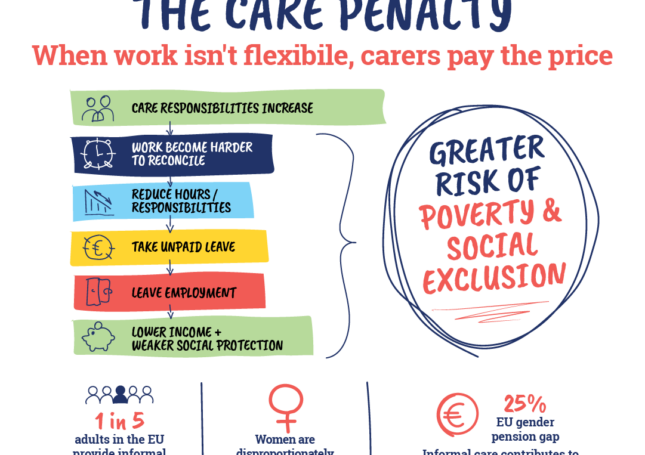
Over recent decades, rapid demographic and societal changes and stringent workforce challenges have placed care services, care workers and families under growing pressure. Today, around 45% of the EU population provides unpaid care, with one in ten people balancing multiple caregiving roles. At the same time, formal care work is often undervalued, with wages in long-term care and other social services in the European Union being 21% lower than the average wage across all workers.
These pressures affect the availability, affordability, quality and resilience of care. The European Union has therefore developed actions to support Member States in expanding, coordinating and strengthening their care systems.
The planned European Care Deal offers an opportunity to connect and strengthen these commitments. The European Commission has confirmed its plan to introduce the European Care Deal in 2027, creating a pivotal moment for renewed EU commitment and action.
The European Care Alliance brings together civil society organisations, social economy actors, public service providers and social partners representing key stakeholders in the care economy: families and the people they care for, whether children or adults; older persons; persons with disabilities; care service providers; and care workers.
Together, we call on the European Commission to take committed action for care by adopting an ambitious, integrated and strategic European Care Deal. In this joint statement, we highlight what we believe the Care Deal should deliver, and we put forward nine proposals for flagship initiatives.
This effort should be based on the mobilisation of EU funding and sustained national investments that respond to the growing pressures on the care sector and recognises that the provision of care is a crucial driver of social and economic well-being. Realising the full potential of the European Care Deal requires strong financial commitments for its implementation under the future EU 7-year budget from 2028-2034.
Shared values and principles
– The Care Deal must be rights and equality based; promote non-discrimination, intersectionality, family diversity, diversity of care models, freedom of choice, human connection and the ethical use of AI.
– Advance fairness, shared responsibility and a strong social Europe.
– Align the Care Deal with the legal obligations arising under the Charter of Fundamental Rights of the European Union, the UN Convention on the Rights of Persons with Disabilities, and the UN Convention on the Rights of the Child, the European Social Charter, as well as with the objectives of the European Pillar of Social Rights.
Introduce objectives and targets
– Set targets for care service coverage and reduction in the number of households unable to access care services because they are unaffordable.
– Track the gender care gap, unmet care needs, access to early childhood education and care (ECEC), including of children at risk of poverty and social exclusion and children with disabilities, and the number of children with disabilities cared for only by their parents.
– Monitor care workforce size, skills and training needs, labour rights and social protection coverage, alongside investment levels in the care sector.
A clear and transparent timeline to measure action
– Set a predefined duration of at least five years and publish a Multi-annual Roadmap integrating the Care Deal’s policy measures and initiatives.
– Organise the Roadmap around ambitious flagships and mainstream care considerations across EU policies wherever this supports the Care Deal’s objectives.
– Schedule assessment and reporting at the mid-term and endpoint of the Roadmap to identify shortcomings and gaps requiring future action.
Strengthened intersectional monitoring frameworks
– Create a structure for multi-stakeholder EU dialogue on care, that feeds concretely into policy design, implementation, monitoring and evaluation, and produces detailed, disaggregated data on the diversity of care needs and care recipients.
– Cover children and adults below and above 65 years old; care needs related to different disabilities, age and illness, including palliative care; unmet needs; risk of poverty; out-of-pocket costs; social protection coverage; type of care received; and territorial inequalities.
– Promote harmonised definitions for better EU comparisons and coordinate ECEC, long-term care (LTC) and work-life balance (WLB) monitoring for a lifelong, integrated view of care needs.
The European Commission should include the following nine flagship initiatives in the European Care Deal.